
August 2026 - Brazilian Crop and Exports
August Report – Brazil
Overview
Expectations of a reduction in planted area for the coming season remain strong, although there is still no consensus on the size of the cut. Some agronomists are working with a decline of 15% to 20%; others see something between 20% and 30%. What they share is the direction rather than the intensity: no meaningful reading today points to the area being held.
On the Russian side, buyers report a larger supply of peanuts coming from Brazilian exporters. Prices, however, have not changed much against recent months, which indicates that the additional availability is being absorbed without shifting the negotiating level.
In the European market, Argentina continues to pull prices up, but demand has not been absorbing the move, given the large volumes the Argentines exported in the first half of the year. It remains a demand that Brazil is unable to benefit from.
Brazil therefore remains increasingly dependent on Russian imports, Chinese oil imports and the domestic market, all of them markets that have so far shown no appetite strong enough to drive the kind of price increase that would change the scenario in the short term.
Exports
July held the strong pace for kernels, even if below the June peak. Some 34,262 tonnes were shipped, 14% less than in June but 6% above July 2025. It is the second-best month of the year.
In the 25/26 crop year, which began in April, Brazil has already exported 128,022 tonnes in four months, against 99,575 tonnes in the same stretch of the previous crop, 29% more.
Peanut oil kept falling: 11,623 tonnes in July, 12% below June and 34% below July last year. In the year to date, kernels are up 27% and oil is down 13%.
Peanuts
Total
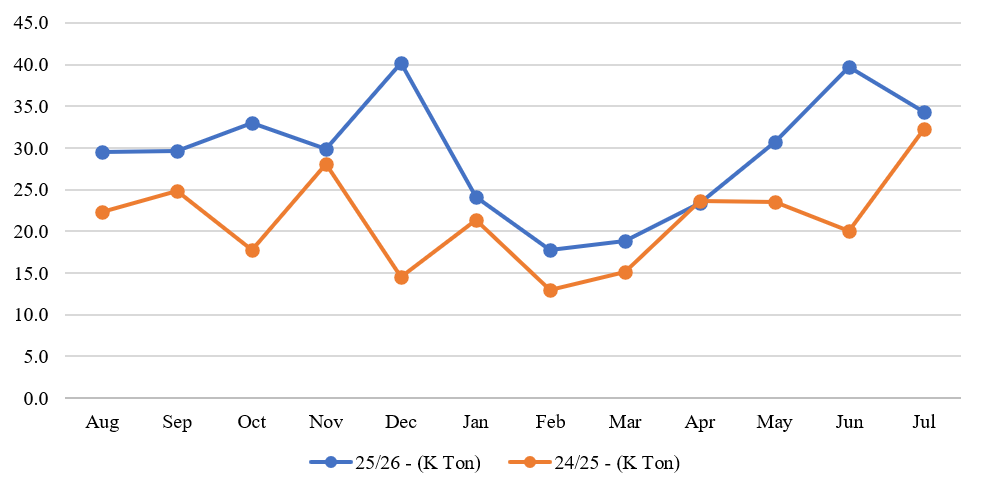
Peanut exports in 2025/2026 x 2024/2025.
Brazilian exports of peanuts, NCM 12024200, ComexStat / Ministry of Development, Industry, Trade and Services.
Kernel exports totalled 34,262 tonnes in July, against 32,317 tonnes in July 2025, a 6% increase. Against June 2026, there was a 14% decline.
In the January to July 2026 accumulated, Brazil exported 188,854 tonnes, against 149,027 tonnes in the same period last year, a 27% advance. Considering only the 25/26 crop year, that is 128,022 tonnes in four months, 29% above the same stretch of the 24/25 crop.
The chart shows the 25/26 curve holding above the previous one since April, with July preserving the gap even after easing from June.
Destination
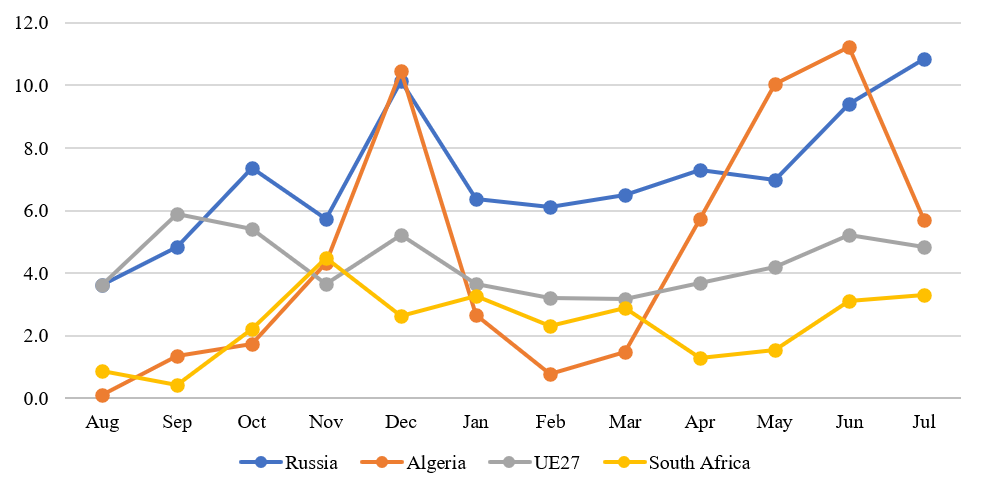
Volumes exported to the main destinations.
Brazilian exports of peanuts, NCM 12024200, ComexStat / Ministry of Development, Industry, Trade and Services.
Russia took the lead for the month with 10,847 tonnes, up 15% on June and the largest monthly volume in the entire window under review. The move is consistent with Russian buyers' reports of greater Brazilian availability.
Algeria fell sharply, from 11,233 to 5,702 tonnes, a 49% decline that returns the country to its April level. The EU27 imported 4,833 tonnes, 8% below June, and South Africa took 3,300 tonnes, its largest volume since November. The four destinations together accounted for 72% of everything shipped in the month.
Peanut Oil
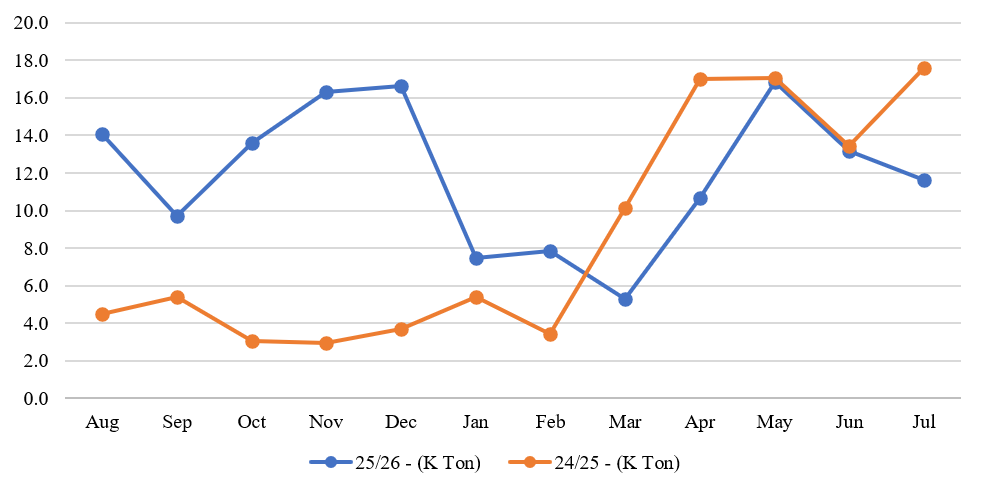
Peanut oil exports in 2025/2026 x 2024/2025.
Brazilian exports of peanut oil, NCM 15081000, ComexStat / Ministry of Development, Industry, Trade and Services.
Peanut oil exports totalled 11,623 tonnes in July, against 17,576 tonnes in July 2025, a 34% decline. Against June 2026, the fall was 12%.
In the year to date, there were 72,945 tonnes, against 84,063 tonnes in the same period of 2025, down 13%. In the crop year the gap is wider: 52,370 tonnes against 65,081 tonnes, 20% lower. After the stability recorded in June, July resumes the downward path in the year-on-year comparison.
Destination
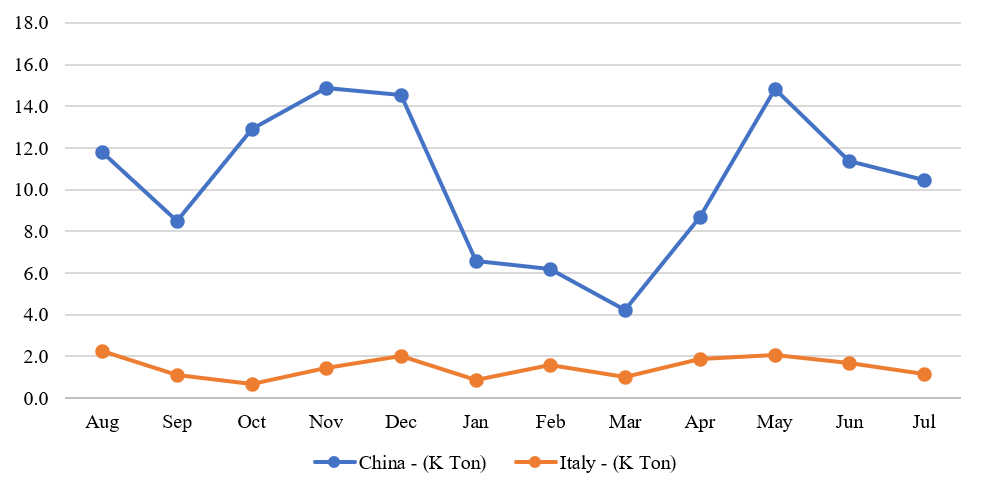
Volumes exported to the main destinations.
Brazilian exports of peanut oil, NCM 15081000, ComexStat / Ministry of Development, Industry, Trade and Services.
China imported 10,467 tonnes in July, 8% below June, and reached 90% of oil shipments. Italy took 1,152 tonnes, down 32% on the month and its smallest volume since March.
Concentration has therefore increased. Brazilian oil depends more and more on a single buyer, and the product's monthly variation tends to mirror Chinese decisions almost in full.
Disclaimer: All information published is verified with several processors and growers in Brazil, and does not reflect personal opinions but rather an average of the perceptions of the main market players. August 28th, 2026.