
Julho 2026 - Safra e Exportações Brasileiras
Relatório de Julho – Brasil
Visão Geral
Apesar do aparente aumento no preço do amendoim em casca, para alguns negócios pontuais, a expectativa para o plantio que se aproxima segue sendo de uma forte redução de área, com comentários se mantendo ao redor de 30% em relação a área plantada no ano passado. Além dos preços que não cobrem completamente os custos dos produtores, os principais problemas para o plantio são a diminuição nas linhas de crédito ao produtor rural e o clima.
Adicionalmente, na última sexta-feira, 24 de julho. Um temporal atingiu a região de Ribeirão Preto, com rajadas de vento que o Instituto Agronômico mediu em 160 km/h. O governo do estado estimou em 79 mil hectares a área devastada, atingindo Taquaritinga, Guariba, Barrinha, Pradópolis, Dumont e a própria Ribeirão Preto, causando perdas severas em estruturas de armazenagem e beneficiamento de amendoim na região, além de perdas propriamente de amendoim em casca. À fim de mitigar os prejuízos, o Estado anunciou uma liberação de recursos financeiros como linhas de crédito.
Por outro lado, o mercado europeu tem se aquecido para negócios pontuais, diante do devagar desenvolvimento da colheita na Argentina. No entanto, os principais mercados de exportação do Brasil, Rússia e Argélia, não têm acompanhado essa subida, portanto a exportação brasileira segue em uma situação muito parecida, bons volumes, mas com preços ainda baixos, o que impede um aumento de preço relevante para os estoques dos produtores.
Nesse contexto, o Brasil se aproxima do período de plantio, setembro e outubro, com uma tendencia a diminuição de área que parece inevitável.
Exportações
Junho foi o mês mais forte do ano para o amendoim brasileiro e um dos mais fortes de que se tem registro. Foram 39.657 toneladas de grão embarcadas, praticamente o dobro do volume de junho de 2025 e 29% acima de maio. Só dezembro de 2025, com 40.225 toneladas, superou esse número na série recente por uma margem estreita.
O que chama atenção não é apenas o volume, mas o contexto em que ele aparece. Dezembro foi um mês atípico, resultado de produtores e beneficiadores esvaziando armazéns antes da chegada da nova safra. Junho não tem esse componente: é uma safra de boa qualidade sendo escoada em ritmo normal de comercialização, no terceiro mês do ano-safra 25/26. No acumulado de abril a junho, o Brasil já exportou 93.760 toneladas de grão, contra 67.258 toneladas no mesmo trecho da safra passada 39% a mais, e a safra anterior terminaria como recorde histórico.
O óleo de amendoim seguiu caminho diferente: recuou 22% em relação a maio, mas se manteve praticamente estável na comparação com junho do ano passado. No fechamento do primeiro semestre, o grão sobe 32% e o óleo cede 8%.
Amendoim
Total
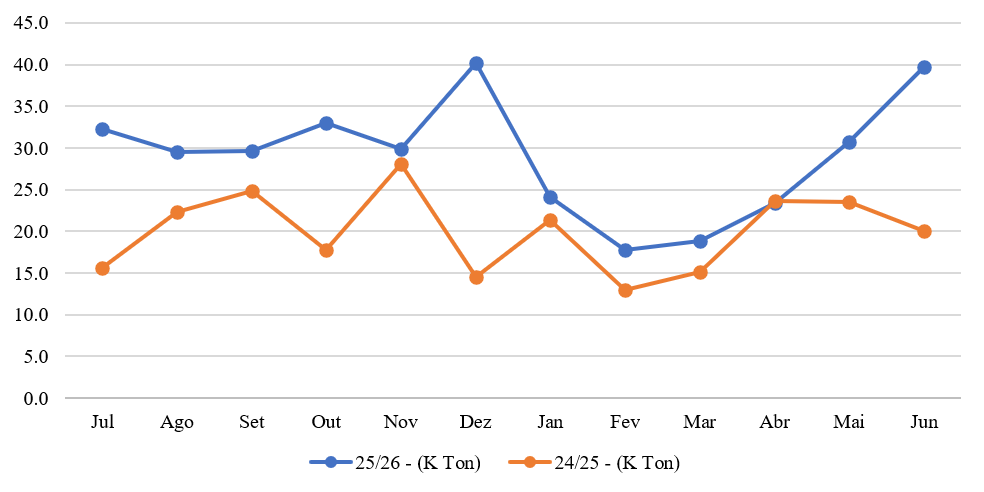
Exportações de amendoim em 2025/2026 x 2024/2025.
Exportações brasileiras de amendoim, NCM 12024200, ComexStat / Ministério do Desenvolvimento, Indústria, Comércio e Serviços.
As exportações de grão somaram 39.657 toneladas em junho, contra 20.094 toneladas em junho de 2025 — uma alta de 97%. Em relação a maio de 2026, o crescimento foi de 29%.
No acumulado de janeiro a junho de 2026, o Brasil exportou 154.592 toneladas, ante 116.710 toneladas no mesmo período do ano passado, um avanço de 32%. Considerando apenas o ano-safra 25/26, iniciado em abril, são 93.760 toneladas em três meses, 39% acima do mesmo trecho da safra 24/25.
O gráfico deixa clara a diferença de patamar entre as duas safras. Depois de um primeiro trimestre em que a curva 25/26 rodou próxima à do ano anterior, abril, maio e junho abriram uma distância consistente.
Destino
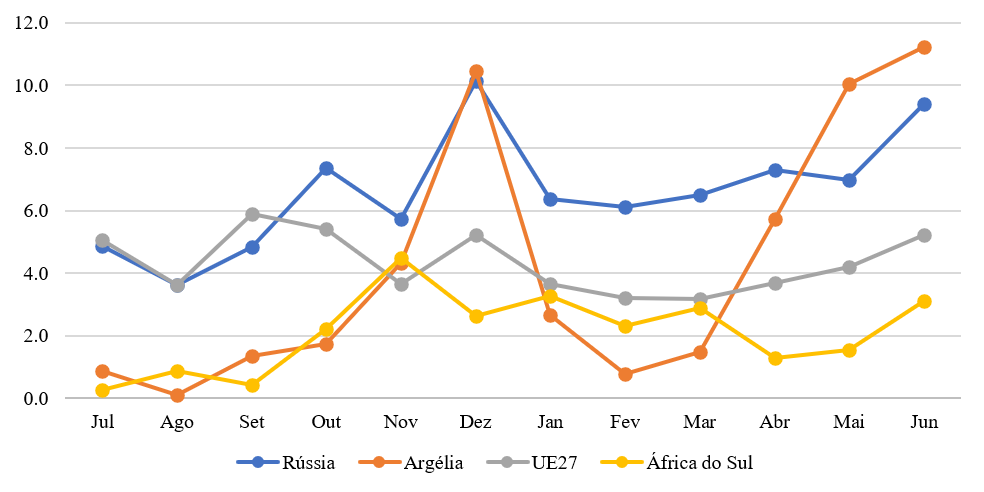
Volumes exportados para os principais destinos.
Exportações brasileiras de amendoim, NCM 12024200, ComexStat / Ministério do Desenvolvimento, Indústria, Comércio e Serviços.
A Argélia liderou os embarques do mês, com 11.233 toneladas, o maior volume mensal de toda a janela analisada e 12% acima de maio. A Rússia veio em seguida, com 9.398 toneladas, alta de 35% no mês. Juntos, os dois destinos responderam por 52% de tudo que o Brasil exportou em junho.
A UE27 importou 5.229 toneladas, crescimento de 25% sobre maio e o maior volume desde setembro do ano passado.
Óleo de Amendoim
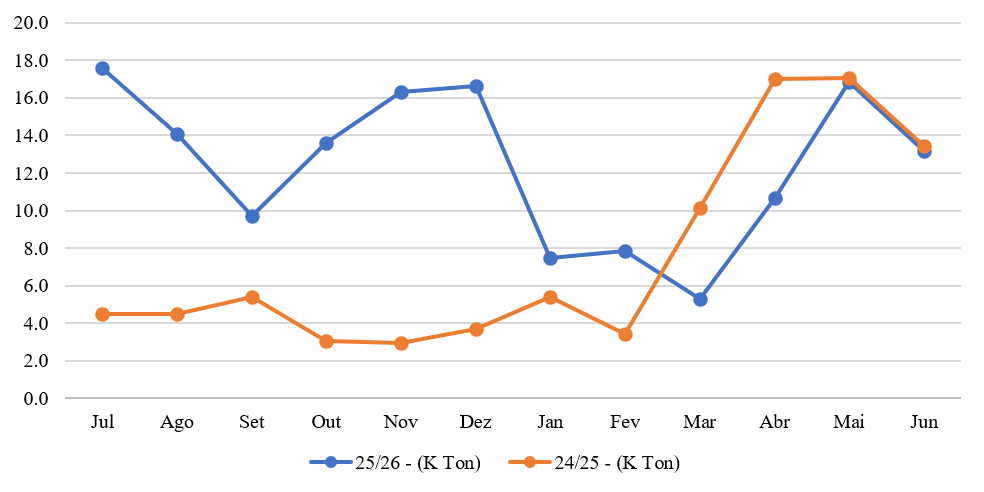
Exportações de óleo de amendoim em 2025/2026 x 2024/2025.
Exportações brasileiras de óleo de amendoim, NCM 15081000, ComexStat / Ministério do Desenvolvimento, Indústria, Comércio e Serviços.
As exportações de óleo de amendoim totalizaram 13.198 toneladas em junho, contra 13.457 toneladas em junho de 2025 — praticamente o mesmo volume, com queda de apenas 2%. Na comparação com maio de 2026, houve recuo de 22%.
No acumulado do semestre, foram 61.322 toneladas, ante 66.488 toneladas no mesmo período do ano passado, queda de 8%. O gráfico mostra bem o que aconteceu: a curva 24/25 partiu de um patamar muito baixo no segundo semestre de 2024 e disparou a partir de março de 2025; a curva 25/26 fez o caminho inverso, começou alta e corrigiu no início de 2026. As duas se encontram agora em um nível semelhante.
Destino
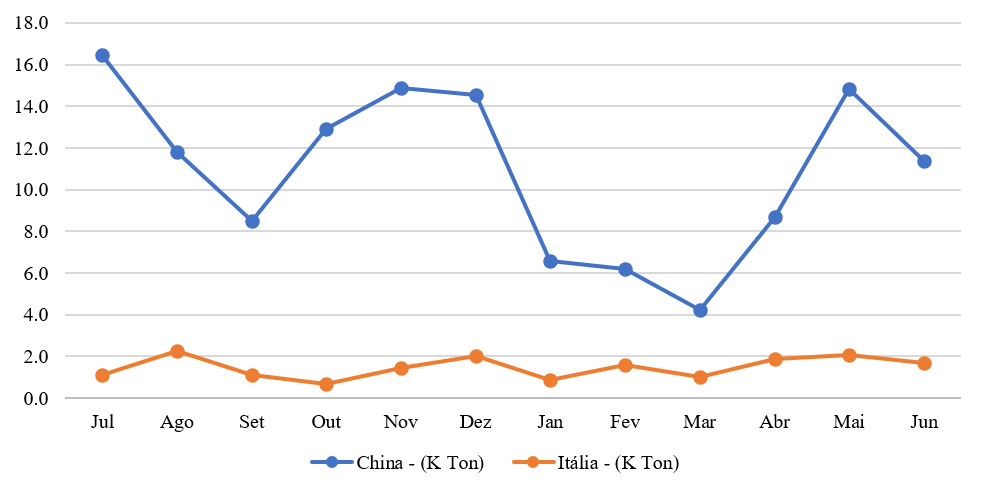
Volumes exportados para os principais destinos.
Exportações brasileiras de óleo de amendoim, NCM 15081000, ComexStat / Ministério do Desenvolvimento, Indústria, Comércio e Serviços.
A China importou 11.393 toneladas em junho, queda de 23% em relação a maio, e segue respondendo por 86% dos embarques de óleo. A Itália ficou com 1.690 toneladas, recuo de 18% no mês.
Os dois destinos caíram, mas a leitura relevante continua sendo a concentração. Enquanto o grão distribui sua demanda entre quatro compradores relevantes, o óleo depende essencialmente da China — e qualquer variação no apetite chinês aparece integralmente no número mensal, como se viu em junho.

Disclaimer: Todas as informações publicadas são verificadas junto a diversos processadores e produtores no Brasil, não refletindo opiniões pessoais, mas uma média das percepções dos principais agentes do mercado. 28 de julho, 2026.